
Services
Useful information

Rules for transporting pets by car
- Safety
- What to take on the trip
- How dogs should be transported
- Ways of securing your pet
- What to bear in mind on the road
- Getting used to the car
- Signs of anxiety
- Cleaning the car
Many people need to take an animal in the car from time to time; most often it is a dog. Anyone doing it for the first time may think there is nothing to it, but when it comes to it, difficulties arise, because the animal has to be kept safe and comfortable on the way.
Safety

Many countries keep all kinds of statistics on vehicle use. According to those figures, most people carry animals in the car while breaking many rules: they use no restraints, do not prepare their pets for the trip, and so on.
Yet this is the basis of safety. If the car is in an accident or brakes sharply, an unsecured animal is thrown forward. It can injure itself and the people in front, and damage the interior.
When a large dog is thrown forward by inertia, the force of the impact multiplies. Say a driver is carrying a 30-kilogram animal on the back seat. In a collision the pet is thrown forward with a force equivalent to about 500 kilograms. A blow like that can have very serious consequences for the animal and for the people in the car.
To avoid this, take transporting animals by car very seriously and follow the safety rules carefully.
What to take on the trip
When taking an animal in the car, pack a rucksack or case with what it needs:
- a bed or blanket (the ones from home rather than new ones: your pet will feel calmer);
- lead, collar and muzzle;
- bowls for water and food;
- the animal's documents;
- water and food for the whole trip;
- towels and wipes for cleaning paws after walks, to keep the car clean;
- your pet's favourite toys;
- a first-aid kit (with hydrogen peroxide and bandages for wounds, a thermometer and the medicines your vet recommends, plus a tick spray).
How dogs should be transported
For a comfortable, safe trip the animal must be securely restrained. It is essential that the dog cannot move around the car while it is moving. A restrained dog does not distract the driver, chew the upholstery or scratch the seats. And if there is an accident, it stays in place and is not thrown through the windscreen.
Ways of securing your pet
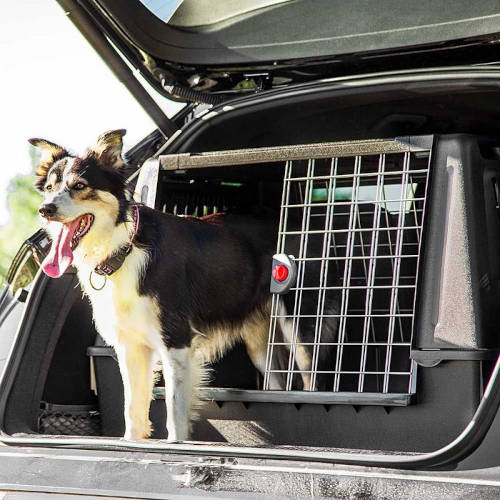
The main ways of securing an animal in the car:
- Held by a person. The simplest and least reliable method: a passenger wraps the lead round a hand or holds the dog by the collar.
Pros: nothing extra to buy; a lead and collar are enough.
Cons: the level of safety is very low. The animal may bite or struggle. Under sharp braking the person may loosen their grip and the animal will be thrown forward anyway. On a long trip, holding the dog the whole time is very uncomfortable.
- Seat belt. This means a dedicated accessory for transporting animals: the dog, in a special harness, is clipped to the car's seat belt, which holds it securely and limits its movement.
Pros: it is easy to fit, and the animal can sit on the back or front seat. Cons: in a sudden stop the belt presses on the dog by inertia, which can cause serious injuries, including internal bleeding and fractures. The belt can also snap at the worst moment.
- Portable cage. Suitable for a small animal or puppy. The cage goes on the floor of the car or in the boot.
Pros: the dog is securely held, the cage is easy to carry and takes up little room.
Cons: the pet's movement is very restricted and the dog is very uncomfortable, so it is not suitable for a long journey.
- Large cage. The ideal option when the car has a roomy boot. Its only relative drawback is that it takes up a lot of space.
- Window grilles. They do nothing to restrain the animal. The only advantage is that the dog will not fall out of an open window.
What to bear in mind on the road
There are some basic rules worth following. Never leave your pet alone in the car in hot weather: the temperature inside rises very quickly. If you have to stop, stay with it and keep the car ventilated.
On a long trip, stop regularly to give the dog water and a walk. The collar should carry the owner's contact details, in case the dog is frightened in unfamiliar surroundings, runs off and gets lost. To protect the upholstery, put down covers and blankets beforehand. A small puppy can be wrapped in a pad.
Getting used to the car
A car journey, especially a long one, is real stress for most animals. To help your pet adapt, do not force it into the car. Let the dog explore and sniff everything at its own pace. You can put its favourite toy or some food inside to tempt it in; this works especially well with puppies.
Once the dog has settled, close the door, start the engine without hurrying and wait a little so it gets used to the new smells and sounds. Avoid travelling on a full stomach: animals can get car sick and vomit. Start with short trips. If the dog becomes anxious and nervous, stop and take it for a walk.
Signs of anxiety
The following signs can show that an animal is anxious:
- faster breathing;
- the dog twitches, rushes about and whines;
- drooling and dilated pupils.
Ideally another member of the family should be in the car besides the owner: the dog will be calmer.
Cleaning the car
After a trip, especially a long one, the interior needs cleaning of dirt and hair. Follow these tips:
- dampen the seats and upholstery slightly: hair is easier to collect from damp fabric;
- settled hair is easier to remove with a stiff brush;
- if you can, use a powerful vacuum cleaner.
The simplest and most effective method is professional cleaning, but it is not cheap. It also uses harsh chemicals, so it should not be done often.


